Dankmar Adler and Louis Sullivan designed the Kehilath Anshe Ma’arav Synagogue in 1890 as a worship and community center for the German-Jewish community in Douglas. As the Black community grew with the first wave of the Great Migration in the 1910s, KAM sold the Synagogue to the Pilgrim Baptist Church in 1922. The Church’s Music Director, Thomas A. Dorsey, was a visionary composer and performer who blended spiritual and blues traditions into the style first called Gospel Blues and, by the 1930s, simply Gospel. Pilgrim Baptist was a landmark in the Gospel world for seven decades, its 3000 seats filling for artists from Chicago, particularly Mahalia Jackson. Aretha Franklin, James Cleveland, and the Staples Singers performed regularly, and Martin Luther King, Jr. preached there during the Civil Rights movement.
Brenda Varghese & Hrushikesh Chavan
The Church burned in a 2006 fire while undergoing repairs to its roof. The entire Sullivan-designed interior was destroyed, leaving only the perimeter walls standing. Thanks to a preservation plan by WJE and Central Building and Preservation, those walls were stabilized and maintained. Meanwhile, community and church members formed the National Museum of Gospel Music and have been working to transform the site into an exhibition and performance center that would both acknowledge the structure’s deep history while introducing new generations to Gospel’s traditions and its contemporary styles.
Basmah Kishta and Raissa Gonzalez
Last summer, we organized a visit to the site for the Construction History Society of America’s annual meeting. Out of that visit and with the help of Rachel Will from WJE and Mark Kuberski from Central Buiding and Preservation, I met with Antoinette Wright, President and Executive Director of the Museum, and Cynthia Jones, Chair of the Church’s Board of Trustees, about basing our Fall Integrated Design Studio on the project. They were enthusiastic about having students generate ideas from their program, and Christopher Lee, from the Chicago design firm Johnson & Lee, generously shared the space plan they had developed.
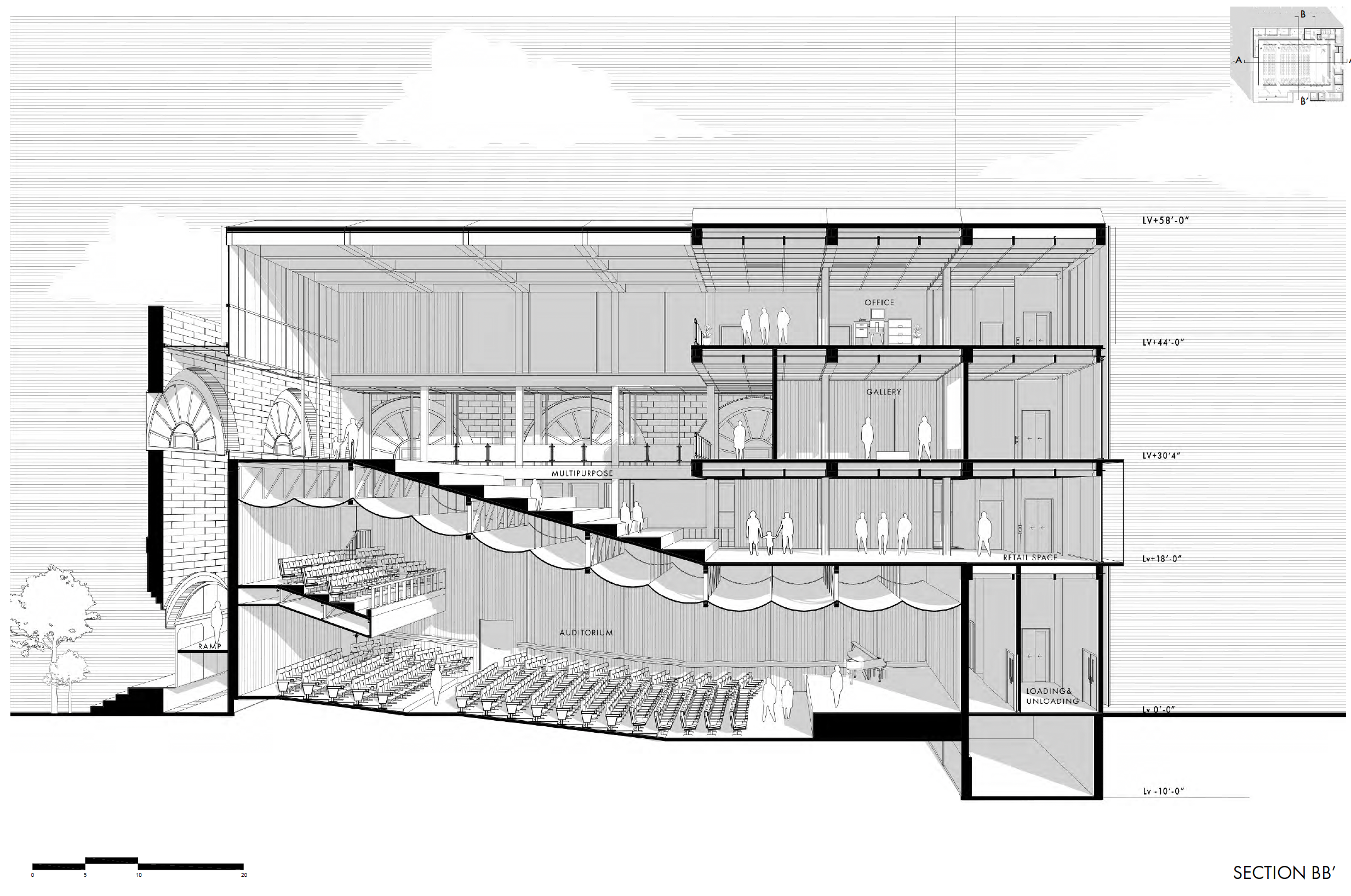
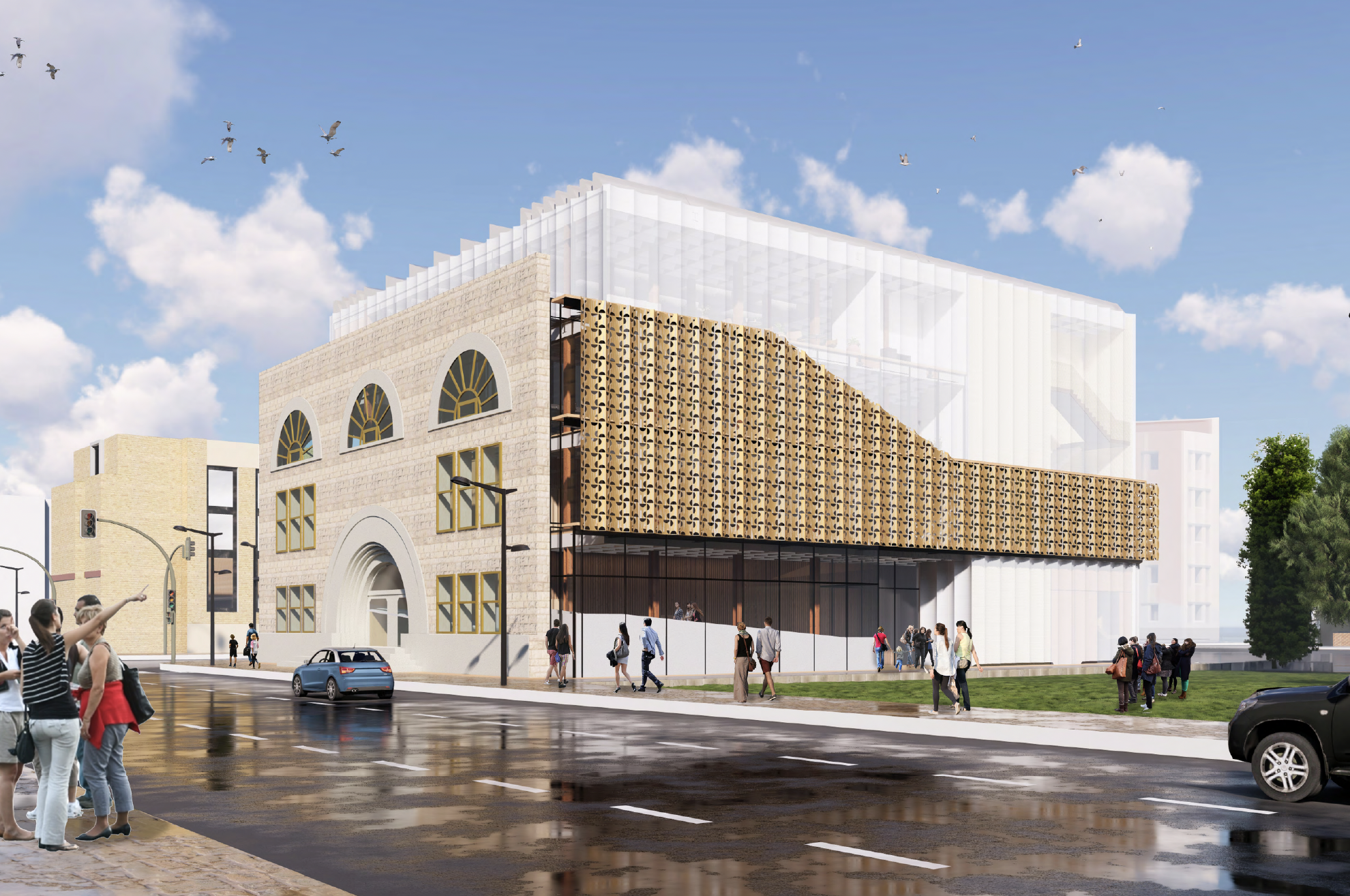
That proved to be a challenging but inspiring brief. Students tackled the problems of wedging a 450-seat auditorium, along with exhibition spaces, offices, public facilities, and extensive back-of-house requirements into the confined footprint of the original Church—while paying homage to the relics of the Sullivan walls. Gospel, we learned from UIUC music postdoc Alonza Lawrence, has both a deep tradition and an energetic range of current practitioners. How to build for a genre that incorporates influences from classical to hip-hop layered additional questions onto the spatial and civic charges the site and program already offered.
Samantha Hendrickson, Lukas Elisha, and Michelle Mo
We took an admittedly liberal view of preservation standards, trying to see the Sullivan elements more as catalysts than museum pieces. But each project found inspiration from the existing compositions—either in massing, detail, materiality, or proportion. Some were inspired by seeing the raw, scarred interiors of the walls, composed of seven layers of structural brick and bearing the marks of the collapsed iron structure within. Those surfaces seemed to tell a more complete history of the original structure and the fire. Others saw opportunities to look forward, with glass skins, metal screens, or timber vaults that extended new interior volumes above or next to the originals, again trying to find a dialogue between the structure’s past, present, and future lives.
Kabir Dole & Harshini Varanasi
Last week, students had the opportunity to present their work in Chicago to Museum and Church board members, as well as a large group of neighborhood residents, city officials, and local church figures. The discussion was lively, and the projects generated a deep discussion about the contexts in which the walls find themselves. While some want a modern museum that reflects the ongoing relevance and vitality of Gospel in its contemporary forms, others hope for a more faithful restoration of the original Church’s massing and interiors. We hope that discussion will continue, at all levels.
Samantha Hendrickson, Lukas Elisha, and Michelle Mo
Many thanks to Cynthia Jones and Antoinette Wright of Pilgrim Baptist and the National Museum of Gospel Music; Rachel Will of WJE and Mark Kuberski of Central Building and Preservation; Christopher Lee from Johnson and Lee; Dr. Alonza Lawrence of the UIUC School of Music, who sat on reviews all semester after talking to us about the history and future of Gospel; and the Illinois School of Architecture, which arranged student travel. An exceptionally enjoyable semester.
Kabir Dole & Harshini VaranasiKabir Dole & Harshini VaranasiSamantha Hendrickson, Lukas Elisha, and Michelle Mo
One of the best parts about getting a book out into the world is hearing how it provokes further thought by others. Chicago Sun-Times architecture critic Lee Bey and I spoke last month at the Newberry Library and had a great conversation about Chicago Skyscrapers, 1934-1986 and the role that high rises have played in the city’s growth over the last century. A real privilege to have the time with Lee (whose own new book project is in the works…) and to push some ideas about skyscrapers’ origins and afterlives.
[Chicago Skyscrapers, 1934-1986, published by University of Illinois Press, is available now on Bookshop.org and Amazon.com, among other outlets. I’m reviving the weekly excerpt in honor of this week’s news about the State of Illinois Center, a building with a far more complicated history than is generally acknowledged. I’ve written before about the dilemma buildings like this pose for preservation. A fuller accounting of its conception, design, and construction should be part of the current discussion regarding its fate.
State of Illinois Center (Murphy/Jahn and Lester B. Knight Associates, 1979-1985).
Jahn’s most noted and notorious addition to Chicago’s downtown arose from the decades-long effort to address the “blighted” North Loop. Adjacent to City Hall and at the north end of the faltering but tenacious State Street retail district, the blocks between State, LaSalle, Randolph, and the River had been a constant irritant to Daley.[i] Greyhound’s 1953 terminal at Randolph and Clark was symbolic of—and a major contributor to—the problem, drawing a constant transient population. Blue Cross-Blue Shield had attempted to anchor the area with C.F. Murphy’s textured concrete exercise in 1968, but it outgrew this undersized building and moved to Illinois Center, leaving the quirky structure empty. The historic 500-room Sherman House Hotel, occupying the full block along Randolph between Clark and LaSalle, closed in January 1973 after losing business to better-located, newer hotels. Renovation efforts floundered in the mid-1970s, and the former stronghold of the city’s Democratic party sat vacant, taken over by the local Teamsters Union after its owners defaulted on a construction loan.[ii]
That year, Arthur Rubloff approached Daley with an outlandish urban renewal scheme, hoping to focus the Mayor’s waning enthusiasm for urban renewal onto the central city. Rubloff proposed using eminent domain to demolish seven “distressed” blocks, including the “bleak, grimy lineup of buildings on Dearborn” that formed the eastern edge of the Civic Center’s plaza.[iii] The Sandburg Village controversy left Daley wary of gifting Rubloff city land without maintaining control over its development.[iv] The project languished, and Daley’s death in 1976 complicated it further. In 1977, Illinois passed legislation that eased bonding restrictions on urban renewal, allowing the prospect of higher property tax receipts to offset purchase prices. This made the city’s involvement more likely, but it negated Rubloff’s agreements with investors, who had been promised enormous tax breaks.
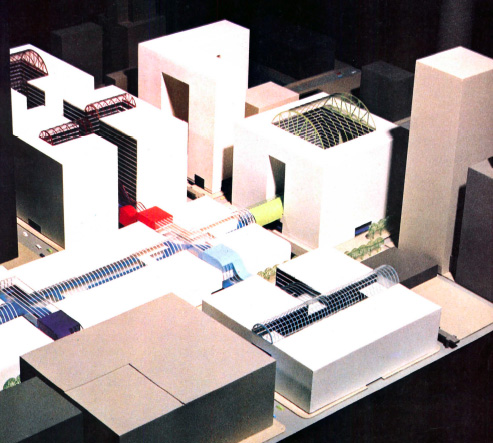
The City of Chicago applied for a $25 million HUD grant in April 1978 to purchase and clear land for the North Loop redevelopment. Rubloff hired C.F. Murphy, with Jahn in charge, to prepare a masterplan.[v] Jahn’s response was a mid- and low-rise megastructure replacing all seven blocks with 2400 apartments, a 60-story office tower, a multi-block indoor shopping center, an 1830-room hotel, and a new public library. All of these were rendered in fortress-like masses, filling blocks to their lot lines and carved out to create inward-looking atria that responded to Rubloff’s preoccupation with suburban white shoppers’ fear of an integrated Loop—Water Tower Place expanded to an even larger scale. Rubloff’s rationale was openly segregationist: “We have two factions downtown, and maybe we’ll have one cluster of multiple movie theaters for each,” he explained by way of example. Fortress-like blocks, skywalks, and closed-off atria would create an interior urbanism insulated from the “urban” population outside.[vi] The masterplan left dozens of buildings to the wreckers; a new library, for instance, was to replace Rapp and Rapp’s effusive Chicago Theater (1921).[vii] Tribune columnist Jeff Lyon led agitation to save the Theater, and the plan drew fire from activists determined to save the Loop from the ‘gigantism’ that had changed North Michigan.
The protesters’ cause was helped by Rubloff’s increasing demands. Lyon speculated that Mayor Bilandic, facing uncertain prospects in the 1979 election, was stringing Rubloff along. Rubloff, misjudging his influence and the new Mayor’s commitment, demanded that all seven blocks be sold to him without a bidding process, that the state agree to a new office building to anchor the development, and that the city commit to financing his scheme if federal funding fell through.[viii] Lyon’s prediction proved prescient, though. The city’s commitment vaporized when Jane Byrne’s anti-machine campaign beat Bilandic in the 1979 Mayoral primary. Just two weeks after the primary, the Metropolitan Housing and Planning Council issued guidelines requiring “several different developers” to be engaged in any Loop revitalization project, preserving the Chicago Theater, and leaving State Street as a pedestrian retail boulevard.[ix] Rubloff was replaced by other developers as the plan devolved. His North Loop plans ended, ignominiously, where he had first gained recognition; the three-story taxpayer he had erected in place of the demolished Masonic Temple in 1938 stood just south of the now-rescued Chicago Theater.
Murphy/Jahn, North Loop Redevelopment. Architectural Record, July, 1979.
While the North Loop plan collapsed, Rubloff had convinced the State of Illinois to implement its corner of the North Loop proposal. It was the last governmental entity foreseen by the Civic Center masterplans to build in the Loop. Daley antagonist James Thompson had parlayed his prosecutions of Thomas Keane and other machine allies into a successful campaign for Governor in 1976. Re-elected in 1978, he sought a greater state presence in Chicago beyond its crowded offices in the 1924 Burnham Building on LaSalle and Washington, and Rubloff convinced Thompson to choose the Sherman House site over a proposal to occupy several historic buildings on South Dearborn.[x] The state put out a request for interest in June 1978, anticipating a one-million-square-foot block to replace the dilapidated hotel. In April, 1979, Thompson’s administration announced that C.F. Murphy would team with mechanical engineers from Lester B. Knight Associates and interior planners from Vickrey-Oversat-Aswum to work with Morse-Diesel, who would serve as construction managers.[xi] The state would allocate $27 million to planning and site development that August—in the midst of a fiscal crisis that saw drastic cuts to other state projects. The city exercised eminent domain to buy the Sherman House from the Teamsters Local Union, transferring it to the State in October.
Murphy’s reputation for intertwining with the city’s governing agencies and its financial community was unscathed by the North Loop debacle. Already attracting attention for his sensational designs and outsized personality, Jahn represented the Murphy office’s transformation into a media-savvy producer of lighting-rod designs. Along with his longtime project architect, James Goettsch, Jahn’s designs for the Xerox Centre, the Board of Trade, and One South Wacker were joined by other provocative projects worldwide. In a manifesto on “New Directions and New Designs at C.F. Murphy Associates” published in Architectural Record in July 1979, he declared that the firm’s recent “eclectic attitude” reflected a synthesis of parallel themes—some of them inherited from Murphy’s Miesian lineage through Brownson and Summers, but others more in keeping with the office’s growing international reputation:
“The functionalist principles of plan, circulation, structure, servicing, and energy are intact, and their communicative quality, their formal character, represent a dovetailing of those basic elements with these: context, as it relates to place and history; space, light, transparency, and reflections, as they establish an enriched visual and physical perception; technical systems, as they make symbolic statements on technology, energy consciousness, and cost effectiveness; with geometry, as it represents a reaching out beyond the reductionist forms of the International Style; with metaphorical associations, using familiar forms, styles, colors, and products to generate form; with communication, as it relates to people’s use and perception of buildings; and with change, which entails both the metaphorical notion and the practical reality that our buildings are never quite finished, that they must accommodate growth physically and can successfully express this impermanence by way of a lighter, more lyrical esthetic.”[xii]
Architectural Record, July, 1979
While this list reflected the postmodern canon of varied interests, many saw it as disingenuously fungible. Lyon, a growing skeptic, described Jahn as “the paradigm of the contemporary architect: slick, facile, market-conscious and media-wise, possessor of a bold, sometimes outrageous architectural vision wedded to a canny gift for showmanship and the irresistible sales pitch.” In other words, in the first media use of the term, a “Starchitect.”[xiii]
Progressive Architecture, February, 1981.
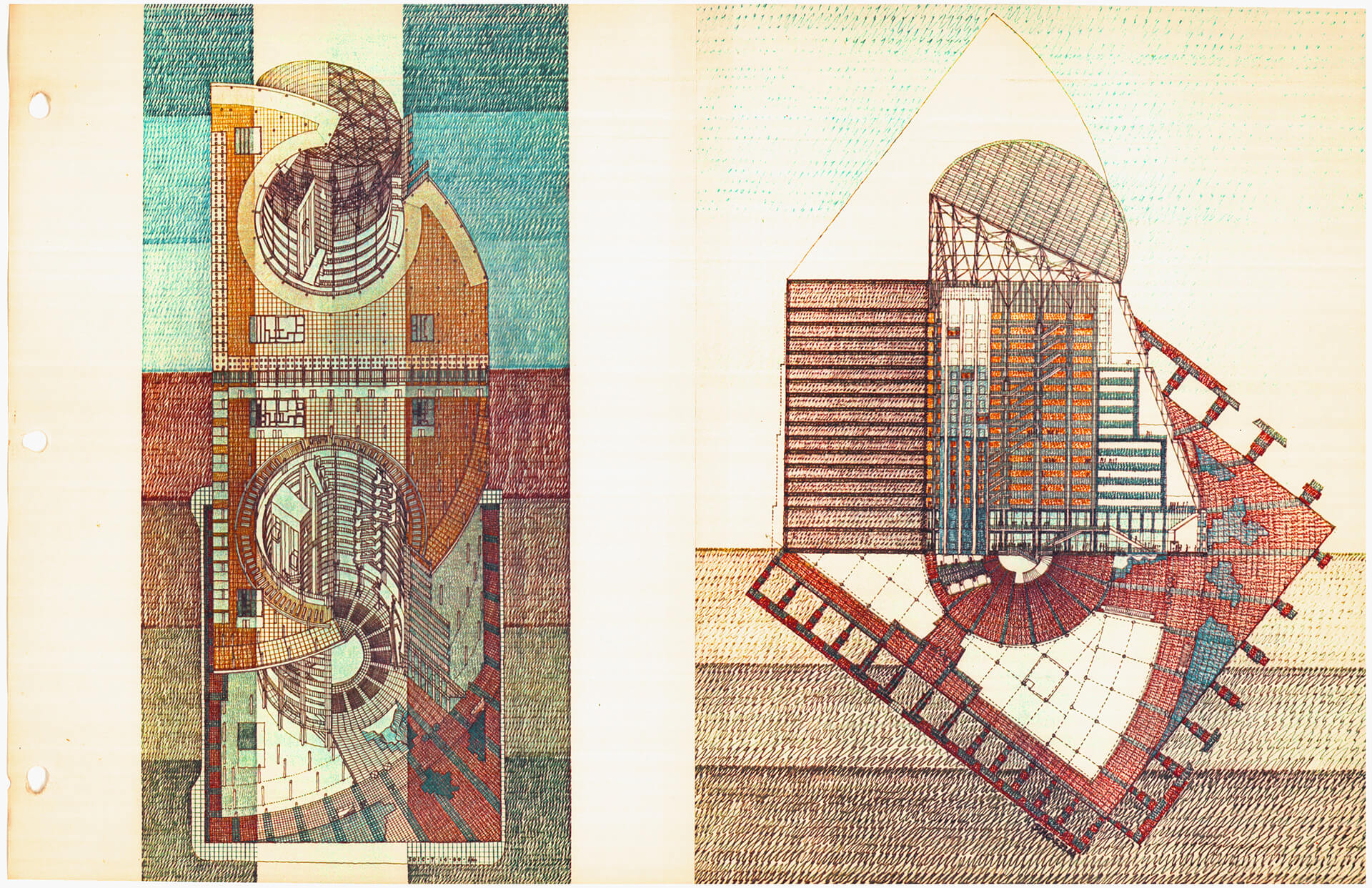
Jahn’s early sketches, published in Progressive Architecture’s preview of the State’s project in February 1981, show this restless eclecticism. His ideas jumped from a central glass dome with diagonal, skylit arcades reminiscent of Milan’s Galleria Vittorio Emanuele to a checkerboard of blocks and equally-sized open spaces to larger, stacked masses with plazas along the south or east half of the block.[xiv] As Joanna Merwood-Salisbury has noted, Jahn’s drawings were within the Beaux-Arts traditions of trying to “show the totality of the building on a single sheet of paper…intended for an audience of architects rather than a client.” Jahn’s axonometric drawings left street-level experience to chance, showing an energetic but noncommittal search instead, bouncing between, in Merwood-Salisbury’s words, “sleek containers given a clear identity through their sculptural form” and “some kind of abstracted historical imagery.”[xv]
Jahn presented Thompson with three of these schemes: a “conventional” 40-story tower on a triangular footprint with a large, landscaped plaza; a full-block low-rise with a long, diagonal slice defining a sloped glass atrium, and a full-block mass, eroded along shallow, concentric convex arcs, with a giant circular atrium punched through it that alluded to the classical tradition of domed public spaces.[xvi] Marvin Romanek, Xerox Centre’s developer, told Lyon in 1987 that Jahn, like any “outstanding architect,” needed a “disciplined client,” but Thompson was nothing of the sort, in Lyon’s view. Instead, he was “an amateur more accustomed to line vetoes than line drawings, and…that dangerous breed, an amateur with esthetic pretensions.”[xvii] The first two schemes’ bland appearance suggests that Jahn was maneuvering his client toward design that would serve its architects’ interests and client’s. If so, Thompson played into his hands. After he selected the atrium scheme, Thompson claimed later, Jahn was “a little surprised…. he was expecting a safe, bureaucratic response, but he didn’t know me.” Lyon, however, suggested that Jahn knew the media-hungry Thompson all too well.[xviii]
JAHN
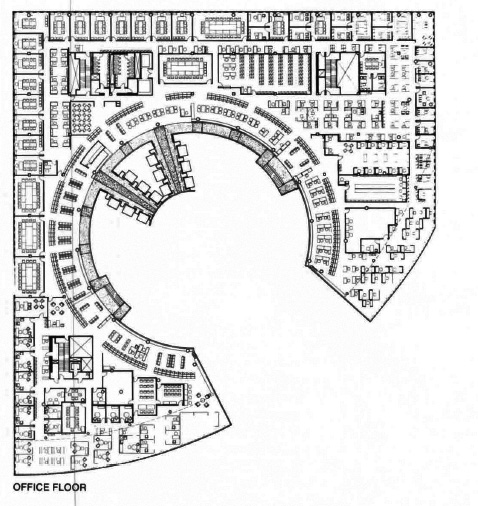
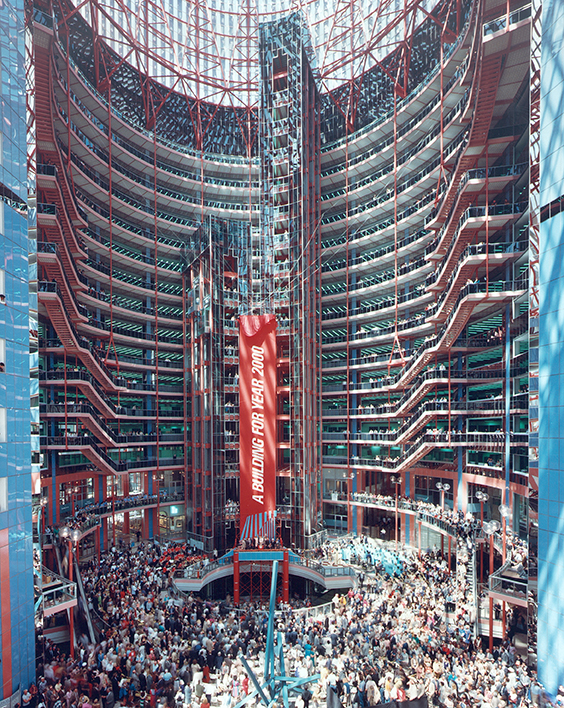
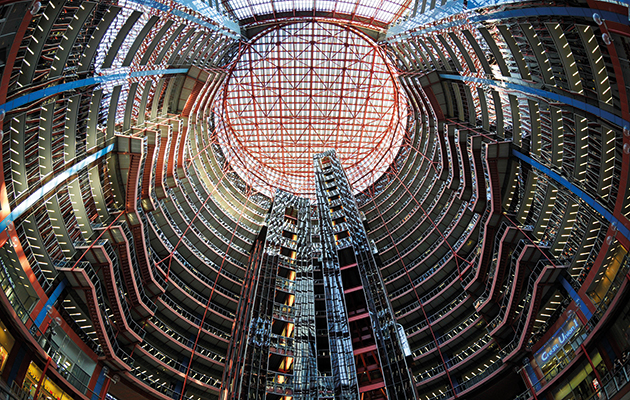
The atrium scheme, published in elaborate exploded axonometric drawings, centered on the rotunda. A broad, wedge-shaped entry led into the 16-story hollow cylinder, with twin banks of elevators jutting into the space and ranks of staircases bracketing it on either side. Escalators descended to a double-level retail and dining plaza, connected to the atrium space through a circular oculus. The office floors’ irregular shapes, stuffed between two curving geometries, presented planning challenges. Three service cores near the block’s corners provided toilets, fire stairs, and mechanical ducts, while the north and west elevations, pressed to the site’s lot lines, were divided into long ranks of single offices. Outside, the curving, sloping southeast façade was rendered in 18 shades and transparencies of vertically oriented curtain wall. Jahn specified insulated structural glazing, capped at the top of the atrium by a finely honed tubular steel network to support the rotunda’s truncated, cylindrical roof. Outside, the block-wide slice of a plaza was punctuated by regular follies that decomposed elements of the building’s block in stages, as if the glass form had been excavated from a now-demolished solid box. Jahn described the overall effect as “synthesizing Modern, Late Modern, and Post-Modern concepts…[an] appropriate and innovative recomposition of Classic and Modern principles of building.”[xix] He compared the glass atrium and rotunda to Henry Ives Cobb’s 1905 Federal Courthouse, which had been demolished to make way for Mies’ Federal Center—making no mention of that structure’s disastrous performance.[xx]
Thompson presented Jahn’s scheme in February, 1980, saying that its rotunda symbolized a “futuristic” center of state government and describing it as “probably the nation’s most energy-efficient” building.[xxi] An analysis by Dr. Vladimir Bazjanac of UC-Berkeley, however, suggested that its environmental performance would rely on a carefully tuned mechanical system and its double-glazed skin, warning that the temperature in the atrium could stray beyond 68° to 78°F three-quarters of the year.[xxii] Bazjanac’s environmental concerns were matched by opposing reactions from the public and Chicago’s architectural community. The Tribune was effusive, praising the “soaring glass skylight and the magnificent open area” and anticipating the “unusually energy efficient” design.[xxiii] Others were less keen, comparing Jahn’s design to a “circus tent” and an “elevated racetrack.” Carl Condit thought it illustrated the profession’s turn toward celebrity and sensation, calling it a “capricious anarchy of forms that is the chief symptom of the disease of neophilia.”[xxiv] Paul Gapp was again enthusiastic—but now cautious, taking note of the “nervous complexity” of the published model photos and drawings. “Jahn is walking a tightrope,” he warned. “There will be no room for false moves as he refines the final details. The craftsmanship of putting the intricate structure together will have to be of the highest order.”[xxv]
Gapp’s review praised the “highly functional” offices proposed, but planning difficulties emerged, and the building’s costs began rising. Its clashing geometries and irregular structural grid led to office plans of baroque complexity. VOAA’s fees for space planning climbed to $1.3 million.[xxvi] Controversy grew over the building’s cost. Thompson presented a figure of $89.8 million, but this was only the construction cost; he and his staff hadn’t included furnishings, which added $25 million. While this sleight-of-hand made the project more palatable to the press and public, Thompson’s elision haunted the project as it attracted greater scrutiny. Bidding problems emerged early. The insulated structural glass curtain wall, estimated at $17 million, was an untested hybrid. Illinois’ Capital Development Board, the State’s managing entity for the project, admitted in March 1981 that no American manufacturers had bid, forcing them to put the project out to international firms. Those bids came in astronomically high, between $49 and $70 million, forcing Jahn to redesign the cladding system. Cupples ultimately won the job after the system was downgraded to single glazing instead of insulated and aluminum-framed instead of structurally glazed. Knight’s office promised that the environmental impact of the change would be minimal. They adjusted the mechanical system, which now included a giant ice-making facility in the basement, to take advantage of lower off-peak rates.[xxvii] Meanwhile, crews began wrecking Sherman House in April,1980.
Construction, undertaken by Gust Newberg and Paschen under construction managers Morse Diesel, ran into problems immediately. A city-wide strike by operating engineers halted work for two weeks in summer, 1981, just as excavation was completed. The empty site filled with water, causing further delays. That December, a gondola carrying ironworkers fell more than 100 feet, killing five in front of horrified midday crowds.[xxviii] This came amidst a worsening state budget crisis. In February 1982, Thompson announced that all state construction—except the Center—would be frozen for six months. Reporters now began comparing Thompson’s $89 million figure with the full project costs; estimated at $120 million, including furnishings, the total figure was now more than $150 million. Thompson and other State officials obfuscated by reiterating the distinction between construction and project costs, even claiming that the project’s construction was, at one point, $9 million “less than estimated.” That estimate, though, soon rose to $171 million.[xxix] “The final cost of the new building,” the Tribune’s Mitchell Locin complained, “will be much more than Thompson led the public to believe. It also will be the most expensive public building ever built by the state.” Changes to the building’s glazing, Locin argued, would mean that “what had been planned as a very fuel-efficient building may become one of the least fuel-efficient structures.” As the project neared completion, it emerged that the Capital Development Board had eliminated new furniture to save money, electing to move old furniture from their existing offices.[xxx] Desperate, the Board also eliminated hundreds of office doors, saving $7.5 million even as the budget finally peaked at over $176 million. State workers were apoplectic. “We have a wide-open government in Illinois,” the Tribune quipped, “though maybe not on purpose.”[xxxi]
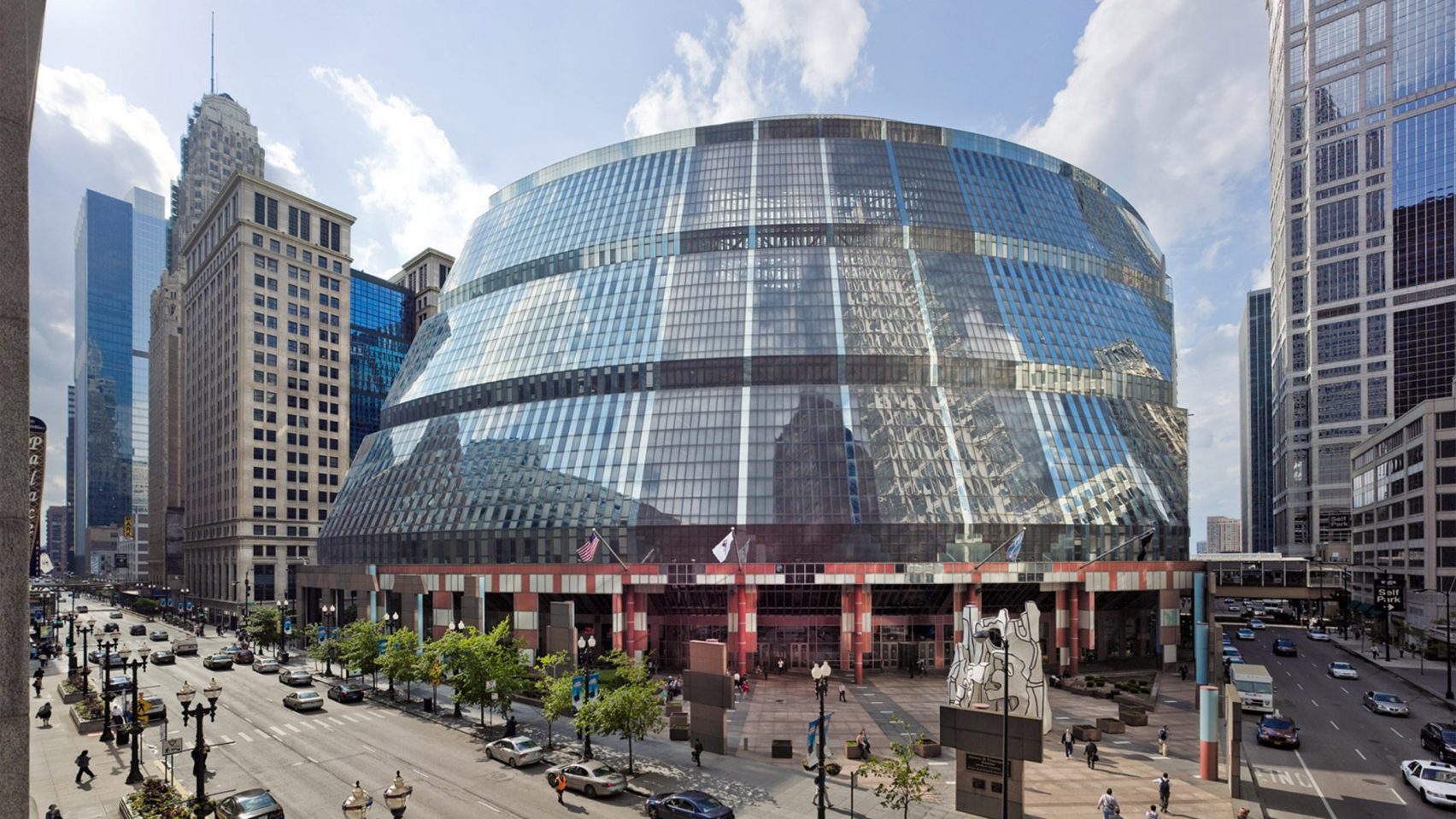
The State of Illinois Center opened formally in May 1985, though it was occupied by state workers and Jean Dubuffet’s “Monument with Standing Beast” beginning in late 1984. Thompson dubbed it “A Building for the Year 2000,” and Ira Bach praised it—without irony—as “our local Taj Mahal.” Critics disagreed, piling on in the wake of the budget controversy. “Starship Chicago,” snorted one headline, while others pointed out the incongruity of its salmon and robin’s egg-blue cladding in a district full of granite, limestone, Cor-Ten, and concrete. The flashy colors and “Buck Rogers” quality seemed, to many, better suited to cities like Miami, Phoenix—or worse. “It’s the ugliest building I’ve ever seen,” the Los Angeles Times quoted one Chicagoan. “It looks like it belongs in Springfield.”[xxxii]
More nuanced assessment came from Gapp, who appreciated the rotunda’s monumental character—a sublime experience, rare in a city of stacked floors, that he described as “tall, broad, soaring, full of interactive light and color.” Gapp admitted, though, that his initial enthusiasm for Jahn’s scheme had, like his reassessment of One South Wacker, been misplaced. “It doesn’t work,” he confessed just before its opening, “not by half.” Its massing had been seductive in model form but from the street it was “a chunky wedge of little grace or elegance.” Worse, as he had feared, “pinchpenny policies” sapped the building’s architectural vitality. “To the building’s chunkiness is added the seeming quality of cheapness…not simply out of context, but tawdry and vulgar.” The detailing that Gapp predicted would determine the building’s quality had fallen short. He pointed to the substitution of flanged steel for tubular in the atrium, adding visual clutter to the space and to the atrium glass’ dusty appearance despite three separate window-washing systems. Gapp tracked this issue down to the substitution, late in the process, of tempered glass for laminated. Laminated glass maintains its integrity even after breaking, as shards adhere to the adhesive interlayer. Switching to tempered glass threatened to rain lethal shards onto the atrium’s occupants—the solution, fine mesh screens, filtered incoming light, making the glass appear dirty. Jahn’s “worst design shortcomings,” Gapp explained, “spring from an incomplete understanding of building materials and a disdain for the details of good workmanship.”[xxxiii] The building split the architectural community, though; it won an honor award from the Chicago chapter of the AIA in 1986, which praised it as a “strong, powerful and important statement,” and “the ‘Pantheon of Chicago.’”[xxxiv]
During its first summer, the Center’s air conditioning failed to keep up with the southeast-facing atrium’s solar exposure and the single glazing that wrapped the remaining facades. Glare led workers to open umbrellas to shade computer screens. Interior temperatures soared to over 90°F that July and chillers, stressed beyond capacity, began burning out.[xxxv] Fixed venetian blinds were installed on the sloped, southeast-facing glazing in 1986 to cut sunlight, and the state commissioned a $2 million upgrade to the ice chilling system. The atrium proved to be problematic in winter, too; employees brought space heaters and blankets to work during colder months. Electricity costs for the structure ran more than a third over estimates, and the building’s murky cost history and perceived environmental failure became a statewide political issue.[xxxvi] In Fall, 1986, the State sued Lester B. Knight—but not Murphy/Jahn. The cost to upgrade the mechanical system ran to over $10 million. Jahn countersued the State to clear his firm of any perceived negligence, charging that Knight had failed to redesign the system after the switch to single glazing. That glazing, too, proved problematic as the building aged; perpetually leaky, by 1998, the “obstacle course” of buckets and tarps required a $950,000 renovation in 1998 that paralleled a $2.5 million replacement of the building’s elevators.
Despite these problems, the State of Illinois Center—and its atrium—proved popular with tourists, Loop workers, and the public. In 1993 it was named for Thompson, who had declined to run for a fifth term and left office in 1991. That the renamed James R. Thompson Center appears, formally, to nip at the heels of the Richard J. Daley Civic Center is a testament to the fraught politics of the city and state, rendered in competing architectural forms and styles that reflect the technocratic image that Daley sought as well as Thompson’s hunger for publicity. Jahn’s reputation never suffered from the building’s troubles. He drew greater recognition for its press and won further city work for the justly-praised United Terminal at O’Hare Airport and its accompanying Piranesian CTA station (1986). He continued to dot Chicago’s skyline—and other cities’—with amalgamations of historicist forms and modern materials, including the jukebox-like replacement for Frost and Granger’s Northwestern Station (1987) and the spired Oakbrook Terrace Tower (1987).
[i] Among other sources, Cohen and Taylor recount this in American Pharoah, 178.
[ii] Alvin Nagelberg, “Sherman House Closing to Mark End of Hotel Era.” Chicago Tribune, Jan 15, 1973. 1-c9.
[iii] Paul Gapp, “North Loop Pins Hopes on Drastic Surgery.” Chicago Tribune, Oct. 7, 1973. 49.
[iv] Ross Miller, Here’s the Deal: The Buying and Selling of a Great American City. (New York: Knopf, 1996). 70-86.
[v] Paul Gapp and Stanley Ziemba, “Rubloff’s North Loop Terms: No Competition.” Chicago Tribune, Aug. 6, 1978. 1.
[vi] Paul Gapp and Stanley Ziemba, “Rubloff’s North Loop Terms: No Competition.” Chicago Tribune, Aug. 6, 1978. 1.
[vii] Jeff Lyon, “A Look at Developer Rubloff and His Designs on the Loop: Close-Up with Jeff Lyon.” Chicago Tribune, Aug. 17, 1978. 1.
[viii] Paul Gapp and Stanley Ziemba, “Rubloff’s North Loop Terms: No Competition.” Chicago Tribune, Aug. 6, 1978. 1.
[ix] Ed McManus, “Group Tells North Loop Plan Guidelines.” Chicago Tribune, March 15, 1979. B8.
[x] “A Sparkplug for the Loop.” Chicago Tribune, Feb. 1, 1978. B2.
[xi] “4 Get State Center Pacts.” Chicago Tribune, Apr. 20, 1979. D5.
[xii] Helmut Jahn, “New Directions and New Designs at C.F. Murphy Associates.” Architectural Record, July, 1979. 98.
[xiii] Jeff Lyon, “Ego Building: Name-Brand Architects May Draw Tenants…” Chicago Tribune, Jan. 18, 1987. H8
[xiv] Jim Murphy, “State of Illinois Center, Chicago: Panoply of Images.” Progressive Architecture, February, 1981. 94-102.
[xv] Joanna Merwood-Salisbury, “This is Not a Skyscraper.” AA Files, No. 75. 2017. 132-149.
[xvi] Ron Grossman, “Starship Chicago.” Chicago Tribune, Feb. 19, 1984. H10.
[xvii] Jeff Lyon, “Ego Building: Name-Brand Architects May Draw Tenants…” Chicago Tribune, Jan. 18, 1987. H8
[xviii] Jeff Lyon, “Ego Building: Name-Brand Architects May Draw Tenants…” Chicago Tribune, Jan. 18, 1987. H8
[xix] Jim Murphy, “State of Illinois Center, Chicago: Panoply of Images.” Progressive Architecture, February, 1981. 98.
[xx] Paul Gapp, “Architecture: State of Illinois Center: Can a Flashy Showplace Turn the Loop Around?” Chicago Tribune, Apr. 13, 1980. D3.
[xxi] Robert Enstad, “New Fuel-Saving Building for State.” Chicago Tribune, Feb. 20, 1980. 1.
[xxii] Vladimir Bazjanac, Ph.D. “Energy Analysis [State of Illinois Center, Chicago].” Progressive Architecture, February, 1981. 99.
[xxiii] “Birth of a Landmark.” Chicago Tribune, Feb. 25, 1980. C2.
[xxiv] “Voice of the People.” Chicago Tribune, Mar. 9, 1980. A4.
[xxv] Paul Gapp, “Architecture: State of Illinois Center: Can a Flashy Showplace Turn the Loop Around?” Chicago Tribune, Apr. 13, 1980. D3.
[xxvi] Robert Enstad, “State Paid 1.3 Million for Illinois Center Plan.” Chicago Tribune, Mar. 27, 1980. N_A2.
[xxvii] Paul Gapp, “Illinois Center Works on Walls.” Chicago Tribune, Mar. 8, 1981. N5.
[xxviii] Douglas Frantz, and Rudolph Unger. “State Starts Probe in Fall Fatal to 5: State Begins Probe of Crane Accident that Killed 5.” Chicago Tribune (1963-1996), Dec 12, 1981. 2-a1.
[xxix] Alvin Nagelberg, “Costs Go Down as State Center Goes Up Here.” Chicago Tribune, Jan. 2, 1983. A7 and “Planned Cost of State Center Here Rises.” Chicago Tribune, Sept. 2, 1982. B1.
[xxx] Mitchell Locin, “State Building Blooming Early.” Chicago Tribune, Apr. 28, 1982. A17.
[xxxi] Maurice Possley and Douglas Frantz, “State Doors Hinge on Cost Cuts.” Chicago Tribune, Mar. 12, 1984. 1 and “Illinois’ Hollow Center.” Chicago Tribune, Mar. 19, 1984. 14.
[xxxii] Larry Green, “New 17-Story State Office Building Stirs Architectural Furor in Chicago.” Los Angeles Times. Oct. 28, 1984. A23.
[xxxiii] Paul Gapp, “Architecture: Helmut Jahn’s State of Illinois Center Is….” Chicago Tribune, Feb. 17, 1985. K16.
[xxxiv] Paul Gapp, “New State Building Honored.” Chicago Tribune, Sept. 18, 1986. E3.
[xxxv] Bill Barnhart and Saville Hodge, “Hottest Topic at New State Building: Can ‘It’ Be Fixed?” Chicago Tribune, July 17, 1985. B1.
[xxxvi] John McCarron, “Heat’s On Governor for High Energy Bill.” Chicago Tribune, June 27, 1986. 15.
AIA Chicago asked me to write about the current state of high-rise building in Chicago and what the future holds for skyscrapers in a work-from-home era. I had thoughts, but I also talked to several practitioners to see where things stand. The article is in the current issue of Chicago Architect(which should be hitting your mailboxes this week) and is online here…
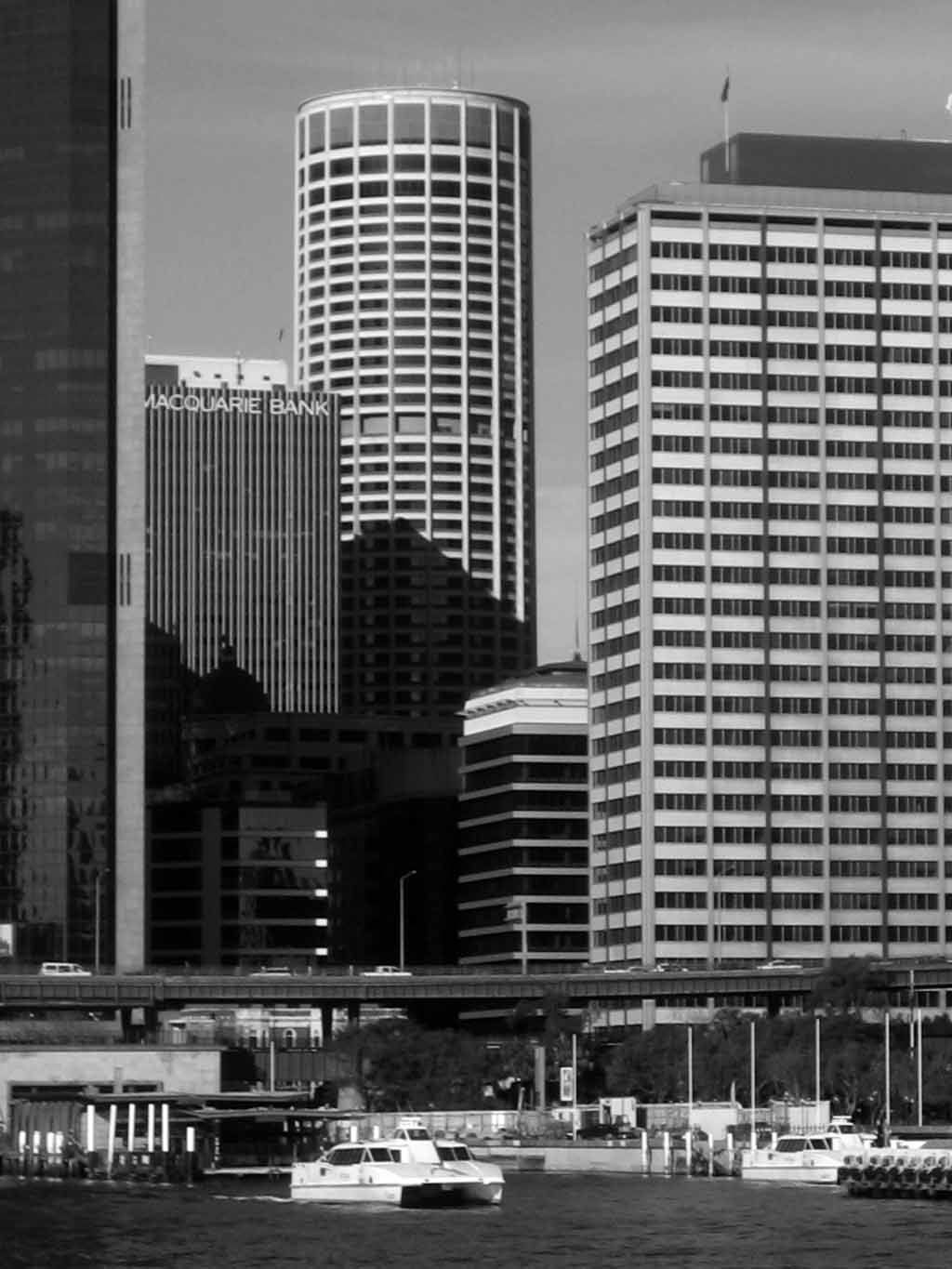
Curator and author Vladimir Belogolovsky will continue the Skyscraper Museum’s In Situ webinar series tonight at 6:00 EDT with a presentation on Australia Square, a collaboration between Harry Seidler and Pier Luigi Nervi that pioneered use of lightweight concrete in high rise structures–and also produced one of the more elegant towers of the era. I’ll be joining in the discussion afterward. Free, but registration required–more details on the Skyscraper Museum’s website here.
Some scouting for a potential next project, and this frankly adorable news item cropped up. In 1927, Chicago was about to build its long overdue replacement for Henry Ives Cobb’s disastrous 1905 Postoffice and Federal Building. It was also in the midst of the air mail revolution and at the hub of a rapidly expanding network of aviation routes that offered unheard-of speed. The city’s air mail facilities moved from Grant Park (!) to Maywood, but the field there wasn’t convenient to the city–fine for mail being transferred but not great for mail destined for downtown. Plans to base air mail at Chicago Municipal Airport (later Midway) were being developed, but that field was undersized, crowded, and about to endure a decade-long fight over its expansion into a reasonably sized facility.
So, why not combine the new postoffice with the air mail field?
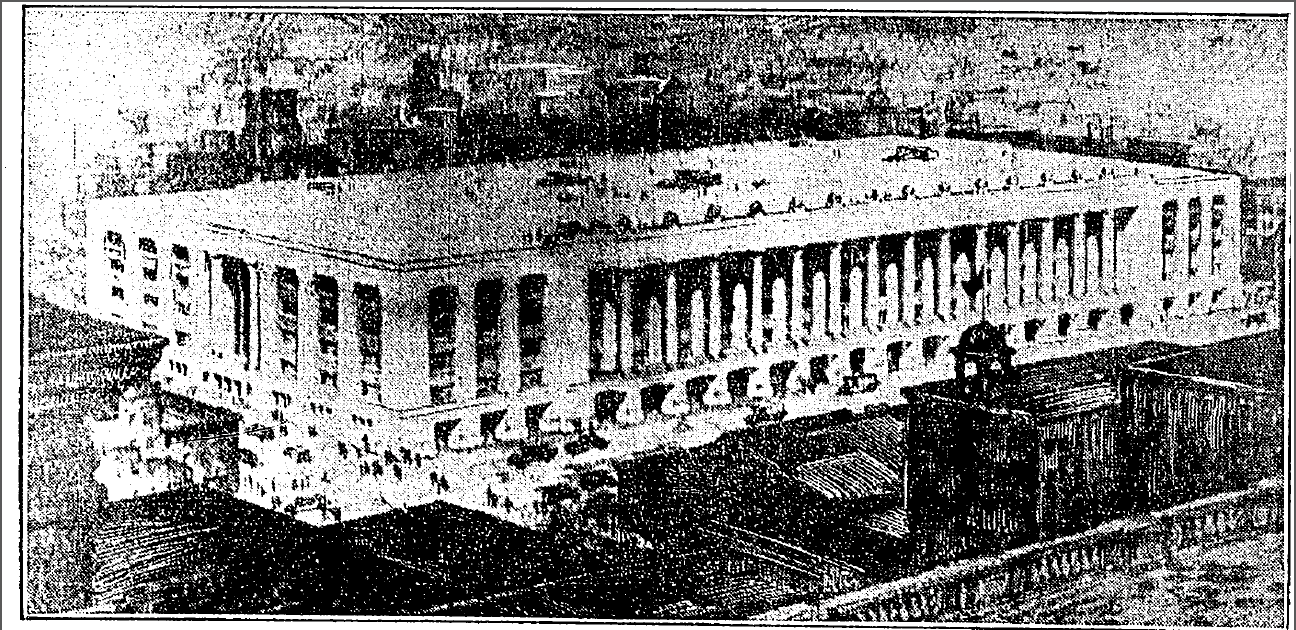
Chicago Tribune, July 21, 1927.
“Plans for new Chicago Postoffice provide landing field for air mail planes” the Tribune announced in July, 1927, along with a rendering–presumably by Graham, Anderson, Probst, and White, but not attributed–of a monumental, neoclassical postoffice for the blocks between Harrison, Polk, Clinton, and Canal streets–with air mail planes wandering around its flat-topped roof.
At six acres, and with a long dimension of just 800 feet, the rooftop was “considered somewhat small for an airport,” but authorities looked at the anticipated schedule for the postoffice and the pace of development in aviation and concluded that “by the time the building is erected the airmen will be able to make it serve their purposes.” Aircraft manufacturers were “now working out the problem of how to stop and start airplanes from a limited area of six acres,” and postal officials were confident that would be solved shortly.
Spoiler alert: It was not. When Municipal did expand from a quarter-mile square to its current mile-square footprint, the primary driver was runway length for new, heavier planes that required more distance to land safely. The new field would feature diagonal 3000 ft. runways–without the proposed postoffice rooftop’s six-story drop at both ends. Similarly, the city’s blithe reassurance that “the height of adjacent buildings would not interfere with the landing of airplanes on the roof” came even as the 555′ Civic Opera Building was breaking ground, less than half a mile north and–definitively–in the flight path of the proposed 600′ runways.
Rooftop airports had been proposed before–there were rumors that the flat top of the Blackstone Hotel would house a runway for airplanes in 1910 (“admittedly,” the Tribune reported regretfully, “not to be used by amateur aeroplanists, for in case of accident the dropping is far and the available spots for alighting are not softer than a well-seasoned cement sidewalk.” And every spiky building top of the 1920s seemed destined to become an airship mooring mast.
But, alas, cooler heads prevailed. The air mail facility was moved to Municipal later that year (a former air mail pilot named Lindbergh helped inaugurate it), and the postoffice design evolved to the four-towered, vertically-striped behemoth that has enjoyed a rebirth as a giant commercial office building. The erstwhile rooftop runways are, in fact, now an outdoor amenity deck. But even if aircraft aren’t landing on top of the Old Post Office, the building maintains the distinction of being one of the few structures to have an expressway burrowing through it, at least…
Daniel Safarik invited me to join him on his excellent podcast, Unfrozen, to talk about Chicago Skyscrapers, 1934-1986, and some of the less savory aspects surrounding high-rise construction in the city during the era. We talked about why this book has a subtitle while the previous skyscraper book did not, tall buildings as chess pieces on an urban game board, how speculative development created very different buildings than corporate headquarters building, and why the John Hancock Building’s construction deserves a screenplay. A great conversation…
Structural engineer Matthys Levy will be talking about his work for Weidlinger Associates on Eero Saarinen’s CBS Headquarters in New York (1965). Admission is free but registration is required; details on the Skyscraper Museum’s website here.
I’m particularly looking forward to this one. Levy’s talk will be the next in a series leading up to the Museum’s exhibit on Concrete Skyscrapers later this Fall, which I’m helping to curate. CBS is (literally) a dark horse in the canon–a building that deserves a lot more discussion and attention than it’s typically had.
Levy (also literally) wrote the book on structural engineering for students, along with Mario Salvadori. It’s a text that I’ve relied on ever since to explain structural concepts to architects, so speaking with him as we’ve pre-gamed his talk has been particularly welcome. Look forward to seeing many of the ArchitectureFarm regulars “there…”








 architecturefarm